Shirts

brother-completed

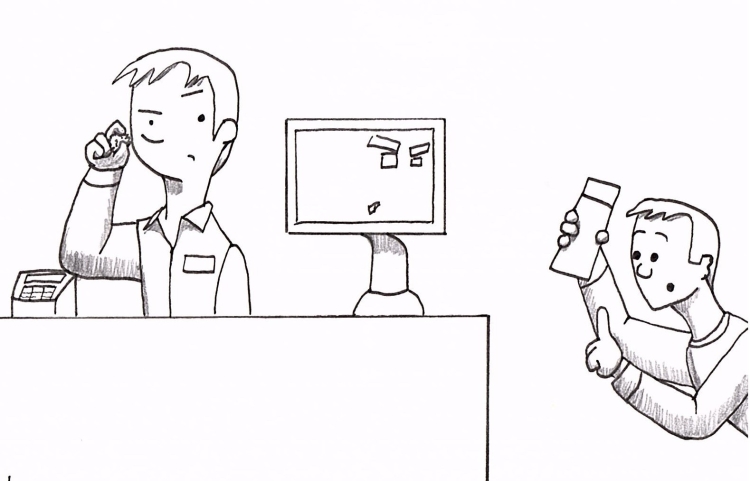
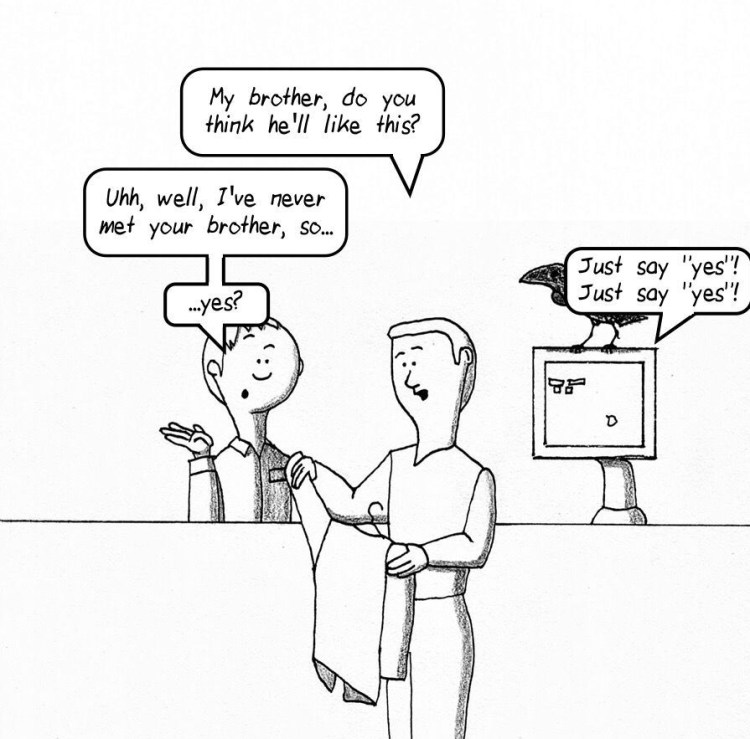
Always say “yes”. It makes a sale and moves them along sooner.

If there’s one item that causes me more headaches than any other, it would be the pilot uniform shirts. “Bane of my existence” really doesn’t begin to describe my loathing for this particular item. Why? Well, I’m glad you asked! It boils down to two basic aspects: 1. There are way too many varieties, and 2. The sizing always causes issues. I. Hate. Dealing. With. These. Shirts.

No one ever knows what they want, and no one ever knows what size they wear. And don’t get me wrong: I absolutely get it. If you’ve never worn an actual dress shirt, you have no idea what you’re getting yourself into. For those of you who haven’t, here’s a crash course. All of our shirts are by neck size, at half inch increments, unless they’re long sleeved shirts, which are both by neck size, but at one inch increments at the half inch, and sleeve length. There are three different styles, which have slightly different features and fits. Also, they’re available in tall sizes and tapered, but not both, and not in long sleeved. Confused? So am I.

When a customer asks about shirts in the store, my first question is always: “Short or long sleeved?” It really helps narrow it down more than you’d expect. Then comes the big question that never gets a straight answer: “Which size?” Deer in the headlights 90% of the time, and that’s no exaggeration. Really, in my experience, that’s par for the course with any item in my shop. Normally, the answer I receive is a prolonged “uhhhh…” but occasionally I’ll get some interesting ones. The other week, I had a customer come in looking for a shirt. I asked him which size he needed. His response? “My size.” Shoot me in the face with a bazooka. Please.

The eventual answer I get is, “I don’t know.” That’s fine, so I simplify: “What size do you normally wear in shirts? (Small, medium, etc.)” When you get an “uhhh” there, then you can begin worrying about that person and their ability to function properly as a human being. When you know the general shirt size, you can narrow it down from there. It just becomes a trial and error situation.

Minivan Moron was my most recent fly-in-the-ointment. He came in one week to try on some shirts and order a bunch of them. After going in circles for a few minutes, we finally land at a size 18.5. (He’s a big dude.) However, he feels the 18.5 is too baggy (because it is; that’s a lot of fabric), and the neck of the 18 is just a little bit too tight. So, we suggest the 18.5 tapered. We order them, and he returns to try them on. He thinks the tapered ones are too short (they’re half an inch shorter than the regular cut), and he’s worried about having to tuck in his tail all the time, while I’m honestly seeing no contest between tucking in my shirt constantly and looking like a fucking blimp all day long, but whatever, they’re not my shirts, and I no longer gave a crap.

So, we ordered the eleven shirts and told him that if they were here by Friday, they’d be waiting here for him to pick up on Sunday. Spoiler alert: They didn’t arrive by Friday. Come to find out Monday morning, he had raised a stink, saying he had an appointment with me for Sunday and a whole bunch of other nonsense. Go figure.

The bottom line is I get more trouble from these shirts, and I get more pushback from customers here than on anything else in the store. I mean, what do I know? I just stare at them all day and fit people in them and fold them (Oh, god, the folding!) and repackage them. Every. Single. Day.

What do I know? I just work here.

-The Retail Explorer

Shopper Profiles: Minivan Moron

Minivan Moron (Sketch)

*shudder*

Round three of Shopper Profiles, and this one’s a doozy. There he is: The absolute bane of my existence. I thought when I changed jobs that I was rid of him. What a fool I was.

Minivan Moron first visited me four years ago, and every time he entered the store, it was always interesting. That’s the nicest term I can apply to our interactions. He doesn’t listen, has difficulty thinking things through, and is generally lazy whenever he shops with me. If there’s a time I haven’t had to explain everything to him three times, I can’t remember it. And it’s not ever anything difficult to grasp, either; he just refuses to listen.

You may chalk this up to a language barrier issue, but that’s a cop out. He’s training here, which means that his books are all in English, his instruction is all in English, and his exams are all administered in English. If language is an issue, he’s never going to pass his check ride here with the FAA. Being from the Congo, he is bilingual in both English and French. To make things easier, I avoid big words around him. Still, the issues persist. It is not a language barrier issue.

The number of instances are too great to count, but there are a few that still stick out in my mind. I recall a three day stretch where he could not figure out how to reduce in size a checklist he had purchased from me, despite me telling him each day that he would have to trim it down with a pair of scissors. On day three, he brought me a pair of scissors and asked me to do it. This is a grown adult with a pilot’s license. (I refused to do it because 1. the whole situation is ridiculous and 2. I’m not going to alter merchandise for a customer.)

Most recently, he came in looking for a pilot uniform shirt. The 18’s were too tight around his thick neck, but the 18.5’s were too baggy on his ample frame. So, logically, we suggested a tapered 18.5. Best of both worlds, right? Not according to him. He wanted that extra half an inch of material so his shirt definitely couldn’t come untucked when he reached up to grab something. An extra half inch. That’s. It. If I’m going to have to choose between looking like a fat guy who’s too cheap/lazy to get a shirt that actually fit me and my shirt maybe coming untucked every now and then to the point I might have to tuck it back in, I’m going to go with the latter. You look better and more professional, and in an arena that really values appearances, that goes a long way.

But what do I know? I only sell the stuff. And work around flight instructors. And airline pilots. You can lead a customer to water, but you can’t convince them that it’s the drink they asked you about when they came in, even though it clearly was, but they ignore you and go search for another oasis elsewhere because you couldn’t possibly know more than them. Yet, I digress…

He once came in with a friend who, sensing the exhaustion and frustration in the tone of my voice, urged me to speak slowly with them, since English wasn’t their first language. As I said before, I purposefully avoided large words (which I do with most customers because I make assumptions regarding customer intelligence), and they must be able to function in U.S. airspace in English, I disregarded that, because it’s a cop-out. No, I will not speak more slowly with you, because I’m already not speaking quickly, and you are able to converse just fine.

Here’s a good example of the importance of conversing in English as a pilot. We have a foreign student who has been working with us since November on a private pilot certificate, and prior to joining us, he had been working for a few months at another school. That’s about two-to-three times as long already as it should take to attain a PPL (Private Pilot License). The reason: confidence issues, particularly in communication. This kid wants to be an airline pilot, and while that’s not an impossible goal, this is a mountain he must conquer. Obviously, it’s of incredibly crucial importance to be able to communicate clearly with ATC (Air Traffic Control). If you can’t figure out how to communicate, you will not make it. End of story. Because, as I’ve stated previously, I hold professional student pilots up to a higher standard.

So, since this is Minivan Moron’s goal, I hold him to that same standard. Why shouldn’t I? What makes him even more frustrating is that he is the embodiment of everything service industry employees despise about customers: the laziness, the arrogance, the aloofness, the stupidity, the stubbornness, the parsimony. As a person, perhaps, he is nice; as a shopper, he is awful.

He came in yesterday to purchase a tie. We have zippered ties and four-in-hand/regular ties; he asked for clip-on. I told him those would be special order only. Then when he looked at the zipper ties, we only had black; he wanted navy blue.

“Is blue the same price?”
Yes.
“You only have black?”
Yes, we’re out of the blue. We’d have to order them.
“Okay. How much is it?”
It’ll be the same price. $19.95 plus tax.
“But you’re out of them?”
Yes. We would have to order them.
“Same price?”

Round and round we go. It’s a merry-go-round of misery with him. And this is a perfect example of how it goes every single time with him. He has a friend who usually shops with him who is just as bad, so it’s double trouble quite often with him. (More on that guy another time.)

Honestly, I could write volumes on Minivan Moron, and I’m sure I’ll revisit him in the future. But for now, I will leave you with this brief window into the madness and the overwhelming joy that you do not have to deal with his bullshit.

-The Retail Explorer

Assumptions

The Longest Checkout 5.4Originally, I planned to title this post “Prejudice” and joke about how I’m prejudiced against customers, but I decided that was in bad taste to go to such a place for a joke (and an admittedly bad one, at that), so I’ll just get to the real root of this post’s sentiment right off the bat. I know I’m a condescending ass, but I like to think I’m a bit more considerate than that. Anyway…

I don’t care who you are, what you look like, whenever you first walk into my store, I will always assume you’re an idiot. I’m sorry if that comes off as a shitty attitude (which, I’ll admit it, it is), but this is a self-preservation mechanism that most shopkeepers develop over time. Far too often, we assume that any given customer is an intelligent being capable of navigating this world with ability and ease, only to be stricken completely wrong. For years, I was shocked when that happened, and sometimes, I still am.

So, why do we just go to this base assumption of a lack of intellect? I mean, this person drove here, so they have enough skill to pass a driving test. (Yes, yes, I know that our driving requirements are not that strict here, but it’s operating a complex machine while multitasking, so I think that’s worth noting.) Going beyond that, they were able to figure out our location, and they were able to get food for themselves, and they were able to dress themselves. That’s a quality skill set right there (even if it is setting the bar low, but then again, this is dear customer we’re talking about here). The bottom line is: they’re capable.

If you’ve read anything on this blog about my time working retail, you know I’m harder on my customers than most. This isn’t a store that sells general goods, like groceries or DVDs; this is a store that caters to people who do something where rigorous standards required and applied to them on a daily basis, and I can’t emphasize this enough: They. Want. To. Fly. You. Around. In. Airplanes. That’s why they get extra scrutiny. They want to be airline pilots, which is why I get concerned when they can’t even figure out which chart is for the Albuquerque area, despite the facts that they are 1. labeled as such and 2. come at the start of the frigging alphabet.

I really don’t think I’m wrong in being concerned with that. A private pilot’s license will cost you around $11,000.00 and will take you around three to four months to achieve, and that’s just so you can putter around in a little Cessna. To fly the big jets, you’re talking years of training, thousands of flight hours, and well over $50,000.00. That’s an enormous commitment. It requires incredible diligence and fortitude to get up to that upper rung of the aviation world. So, you cloud imagine my shock when I hear them be confused by which oral exam guide is the correct one for their particular flight test, despite the fact that those are extremely well labelled and straightforward.

More troubling still is the large percentage of shoppers who cannot for the life of them read price tags or basic signage. From hours of operation to sale signs, so much of it goes unread or outright ignored, despite the their being read as their exclusive reason for existence. My absolute favorite (or is that “most loathed”) moment is when a shopper yanks on the locked door of a shop with a sign that reads “CLOSED”.

I still remember one morning pulling up to the shop about ten minutes before opening. Seeing as it didn’t take but a few minutes to run through my opening procedures (and the fact that I wouldn’t get paid for anything more than that), I never showed up earlier. On that morning, I watched a customer walk up to the door, yank on it, then stand there dumbfounded. As I walked up, he approached me and said, “There you are! I have been waiting for you for a while! I was wanting to buy something but I didn’t know when you opened!” I politely informed him that we did not open until ten. “Well, how was I supposed to know that?!” I then pointed out that we had a sign on the door outlining our hours of operation. “Oh.”

Honestly, I find that to be a bit amusing, but the great bane of my existence will forever remain: “How much is this?” Did you even look? I get it that sometimes, products get mispriced or missed altogether, but when they’re on there, they’re on there.

I’ve touched on the reasons behind this before. Often it just boils down to laziness. Whatever it is, I’m not getting into it here. The main problem is that it happens often enough to the point that I just gave up. It was far easier to assume they could do nothing and knew nothing. If they want to be treated like children, I was going to do it. Part of me still refuses to hand-hold fully capable adults like they’re toddlers through an area designed to make their experience as simple as possible. However, assuming I will have to do that with everyone who walks into the shop lessens the impact when that assumption becomes the reality. Then there’s the added pleasant surprise when it turns out that they actually are capable adults.

There’s no problem with asking for help. Sometimes, things are laid out differently from what you would expect to be the logical footprint. Sometimes, stores are so massive that it’s difficult to figure out where something should be found. That’s okay. That’s not what I’m talking about here. What I’m talking about is the shopper who enters a shop, takes a look around, spiritually throws up their hands, and gives up all hope of doing anything on their own. If you’re unable to flip a product over and look for a price tag, if you’re unable to figure out when we close, if you’re unable to read a package, I am perfectly happy treating you like the lost, helpless toddler you’ve shown yourself to be.

Shopping is not difficult. It can be challenging, yes, but not difficult. There are people whose entire job it is to study the interactions of customers with their stores and how they can improve their layouts and policies to better help customer shopping experiences. Customer service and sales reps are there to make it easier, as well. But as I’ve said before, I assume that they will be able to do nothing. I assume that you will be difficult, that you will be lazy, that you will be useless, because I’d much rather not waste my time and cut to the chase or be pleasantly surprised. I’m sorry if that sounds harsh or anything, but that’s how I’ve been twisted by years of dealing with the laziness of a customer base that really shouldn’t be lazy or aloof. I’ve been warped. I’ve been jaded. I’ve been broken. Now, I just assume it’s going to be a rough time from the moment you leave your car. It’s just easier that way.

-The Retail Explorer